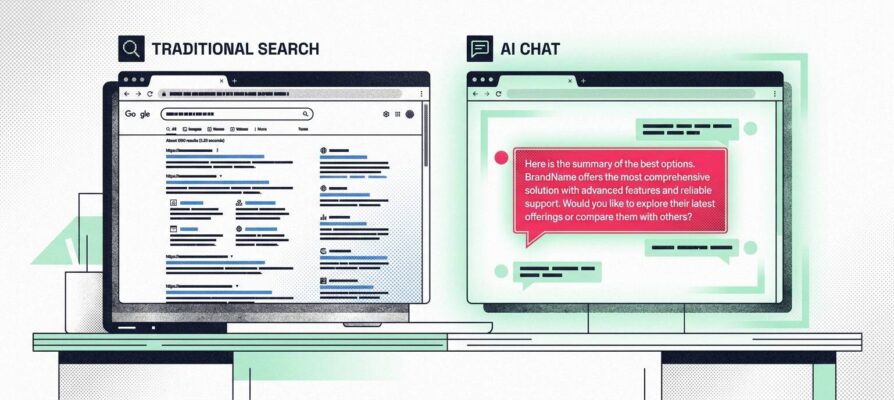
Your keyword report says you win. Then a prospect asks an AI assistant to recommend a provider in your category, and your company is missing from the answer. The report counted phrases. The assistant went looking for companies it recognizes.
Keywords are still worth optimizing for, because Google and other traditional search engines continue to use them to surface relevant content. Entities (real-world things such as companies, products, and people) are the way AI models match search queries to the relevant answers. These are simply different underlying processes: keywords help earn visibility in search results, and entities in AI answers.
The practical question is what to change in your content, and one popular piece of advice, schema markup, no longer belongs on the list. First, the mechanics.
How Keywords and Entities Work in SEO and GEO
The same page now gets judged in two ways. SEO, search engine optimization, means winning visibility in classic search results. GEO, short for generative engine optimization, means getting your company named or cited inside AI-generated answers.
Five points cover what you need to know:
- Keywords: phrases people type, matched by meaning rather than letter by letter
- Entities: the real-world things behind those phrases, stored as single identifiable units
- Who uses what: Traditional search relies on keyword matching to surface relevant content, whereas AI models understand the entities behind queries
- Evolution: search moved from matching words to matching meaning, and AI search now recognizes things
- Optimization: write naturally in your customers’ phrasing, describe your company identically everywhere, and skip schema
Each point in turn.
What Are Keywords?
Keywords are the words and phrases people type or speak into a search engine, and for years they have been phrases such as “ad agency in Zurich” or “how to report sales by region” rather than single words. Google matches the meaning of a query to the meaning of a page, a method called semantic search, so exact wording matters far less than it once did.
Say you sell a “revenue operations platform” and your customers search for “sales reporting tool.” If your product does that job, Google connects the two without help. If the products are genuinely different solutions, Google and AI tools keep them apart. Repeating a phrase on a page earns little. Keyword research still has a job: it shows the phrases customers actually use, and those phrases belong in natural text about what you offer.
What Are Entities?
An entity is a real-world thing that a search engine can pick out as one distinct unit, such as a company, a product, a person, or a place. Take the word “apple.” Typed into a search box, it is only a word, and the engine has to decide whether the person means the technology company or the fruit. The word is the keyword. The thing the engine settles on is the entity.
Search engines store each entity with facts and connections attached. Google’s Knowledge Graph, its database of such things and how they relate, is the visible example: search a well-known brand and the information panel beside the results is built from it.
When Is Each One Used?
Which one gets used depends on the system answering the question. Google still relies on keywords to match queries to pages, while AI search systems work largely from entities. An AI assistant pulls in sources, finds the entities inside them, and treats those entities as the answer.
When someone asks an assistant for a good provider in a category, it has to produce names, so it picks the ones it can identify with confidence and describe accurately. AI engines trust an entity much more when what is written about it matches across its own website, news coverage, and social channels. Trust also grows with the number of entries across all those channels. Under keyword-based ranking, a company’s own site and links from other sites carried most of the weight. How each AI product selects its sources is not public and changes often, so treat this as reasoning from how these systems work rather than a published rule. We hold the position anyway: in AI answers, being recognizable and consistently mentioned across different channels beats being repetitive.
How Are They Evolving?
Search has moved in stages: it matched literal words first, then matched meaning, and now AI search recognizes things. Early search engines compared the letters in a query with the letters on a page. Google then moved to phrases and meaning, and AI search goes one step further by building answers from entities.
The older layers did not disappear. Both systems now run side by side, and one piece of content gets read by both. That is why the question “keywords or entities?” has no single answer: these simply represent different underlying systems to retrieve relevant information.
How Do You Optimize for Both?
Content that works in Google and in AI answers needs two things: natural phrasing and consistent company information across your website and all relevant channels.
Write in your customers’ phrasing, naturally. Cover each topic from different angles and let the relevant keywords and synonyms appear on their own. An ad agency that describes its work well will say “ad agency” without being told to, because writing about a company without its keywords is close to impossible. In this way, you’ll automatically use relevant keywords that describe and build your entity.
Describe your company the same way everywhere. Write one agreed description of the company, its offerings, and its people, then make every public profile match it, from your website to LinkedIn to directory listings and press material. More matching entries across more channels build trust.
Skip schema. Schema markup is code that labels in machine-readable terms what a page is about. It used to be standard advice, and studies have found it makes little difference now. Google has started phasing out some schema types, FAQ schema among them. AI models still recommend schema because that advice appears so often across the web (especially from those selling you schema-related services). SEO has largely moved on from it, and the effort is better spent on the consistent description above, which is what makes your brand findable to both Google and AI engines.
Our Recommendation
Treat keyword and entity visibility as two jobs done in one piece of content. Phrase it the way customers search, for Google, and describe the company the same way everywhere, for AI search. Stop treating keyword rankings as the whole scoreboard, and stop paying for schema work as an AI fix.
The trade-off is speed. Consistency work is slower and harder to put on a dashboard than a batch of new keyword-targeted articles. Keyword reporting is easy to produce and easy to sell, so most proposals lead with it, which makes consistency the less crowded part of the job. Current tools can show whether a brand appears where it matters and where its AI visibility has gaps. They cannot rank which fix comes first. In practice, the first fix is often on your own website, and that check can start this week.
Your Next Steps for Keywords and Entities
Write in your customers’ words and describe your company the same way everywhere. Before commissioning more keyword-driven content, check how consistently your company, people, and products are described across your site and the wider web. In practice, that means comparing how your website, social profiles, and press coverage describe what you sell. Contradictions and gaps show you what to fix, and your own website is usually the quickest place to start. Repeat the check regularly, because the way search engines and AI tools pick their sources keeps changing.