
The AI Visibility Index from Advance Metrics shows who appears in the answers of the major AI models, who doesn’t, and why this is becoming a question of visibility for every bank and financial service provider.
More and more customers are putting their questions about banking products straight to ChatGPT, Gemini or Claude. Which bank has the cheapest private account? Where is the best place to invest Pillar 3a savings? Who offers the lowest mortgage rates? To questions like these, AI models now give concrete recommendations, and most users take them at face value.
That is exactly what we set out to study systematically at Advance Metrics. The AI Visibility Index 2026 is our study series on the AI visibility of Swiss companies, and this edition focuses on banks and financial service providers.
AI Visibility for Banking and Finance Questions
We looked at 13 categories: private accounts, savings accounts, credit cards, consumer loans, mortgages, private pension savings (Pillar 3a), vested benefits accounts, wealth management, investing & trading, pension planning & retirement advice, independent financial service providers, financial advice and business loans.
- No clear winner, but strong specialists: UBS leads in 3 of the 13 categories and Raiffeisen in 2. The remaining 8 categories go to 8 different providers. Neon beats every traditional bank in private accounts, VIAC leads in Pillar 3a, Finpension in vested benefits accounts and Swissquote in trading.
- Credit Suisse is still being named: Although it no longer exists as an independent bank, Credit Suisse picks up 1,441 mentions across all 13 categories, and Claude names it in 37% of its answers. More on this below.
- Anyone looking for independent advice is pointed to banks: In the independent financial service providers category, 86% of mentions go to traditional banks, while independent advisers get just 1.1%. Even when the question is about financial advisers who are “not tied to product providers”, 79% of mentions go to traditional banks and only 17% to independent advisers.
- Names and brands split visibility: The raw data contained 668 spellings for roughly 270 providers, and product brands build up visibility of their own: Zak gets 787 mentions, more than Bank Cler (765), the bank behind it. More on this below.
- The models disagree: Interactive Brokers in the Investing & Trading category shows just how far apart they can be: Claude names the broker 173 times, Gemini 111 times and ChatGPT only 3 times.
Results: Which Bank Dominates Which Category?
Across the 13 categories studied, the picture is split in two: five big names show up in every category, but in six categories a different provider comes out on top. UBS, PostFinance, Raiffeisen, Zürcher Kantonalbank (ZKB) and Migros Bank together account for 47% of all mentions. Across all categories, UBS (4,999 mentions) and PostFinance (4,926) are almost level, ahead of Raiffeisen (3,915), ZKB (3,786) and Migros Bank (3,451). ZKB does not lead in a single category.
In private accounts, three digital offerings sit ahead of all the traditional banks: Neon leads with 546 mentions, followed by Yuh (444) and Zak (439), and only then come PostFinance (406) and UBS (317). In savings accounts, by contrast, PostFinance leads (488) ahead of Raiffeisen (374) and UBS (332). In credit cards, UBS is in front with 442 mentions, ahead of Migros Bank (365), Cembra Money Bank (338), Swisscard (305) and PostFinance (304). Migros Bank dominates consumer loans (683) ahead of Cembra (611) and PostFinance (502), and Raiffeisen leads in mortgages (688) ahead of PostFinance (624), UBS (577), ZKB (556) and Migros Bank (505).
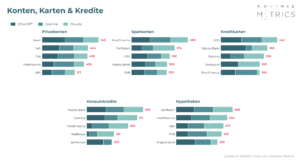
In pensions, digital specialists beat the established banks. In Pillar 3a, VIAC (504), Finpension (486) and Frankly (458), ZKB’s digital offering, lead clearly ahead of PostFinance (262), Selma Finance (247) and ZKB itself (218), and Claude names all three front-runners in every single one of its answers. In vested benefits accounts, Finpension (377) and VIAC (362) are ahead of UBS (318).
In wealth management, UBS dominates (511) ahead of the private banks Pictet (423), Lombard Odier (416), Julius Bär (398) and Vontobel (324). In investing & trading, Swissquote is in front with 692 mentions: the broker appears in 98% of all answers in this category. It is followed by PostFinance (534), Saxo Bank (329), UBS (312) and Interactive Brokers (287).
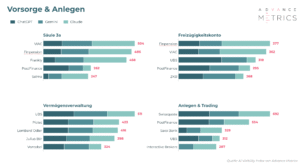
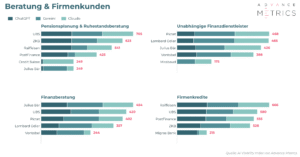
In pension planning, UBS leads with 705 mentions, appearing in every single answer from all three models (100%), ahead of ZKB (623), Raiffeisen (541) and PostFinance (425). Credit Suisse and Julius Bär are level in fifth place with 249 mentions each. Among independent financial service providers, Pictet (468) and Lombard Odier (465) are locked in a photo finish, ahead of Julius Bär (426), Vontobel (388) and Mirabaud (175). In financial advice, Julius Bär (454) leads UBS (420), Pictet (402), Lombard Odier (357) and Vontobel (244). In business loans, Raiffeisen dominates (666) ahead of UBS (580), PostFinance (555) and ZKB (528).
What stands out is who barely appears in the two advisory categories. Among independent financial service providers, where all five questions explicitly ask for independent providers, 86% of mentions go to traditional banks. Pictet, Lombard Odier, Julius Bär and Vontobel alone account for almost half of all mentions (1,747 of 3,520). Independent advisers and asset managers reach 1.1%, and the best-placed of them, VZ VermögensZentrum, gets 35 mentions. In financial advice, one of the five questions explicitly asks for advisers who are “not tied to product providers”. Even for this question, 79% of mentions go to traditional banks and 17% to independent advisers; across all five questions in the category, the figures are 87% and 3.5% respectively. It is not unreasonable that private banks such as Pictet or Lombard Odier get named, since both are partner-run and describe themselves as independent. But anyone looking for an adviser with no products of their own is mostly pointed to institutions that sell products themselves.
This split by product makes sense, with one important caveat: universal banks such as UBS, Raiffeisen or ZKB offer a product in practically every category and so are a possible answer everywhere, whereas specialists such as VIAC, Finpension or Swissquote can only count in their own field. Anyone who has built a credible position in a particular product gets recognised by AI for exactly that product, regardless of the institution’s size.
Deep Dive: Credit Suisse
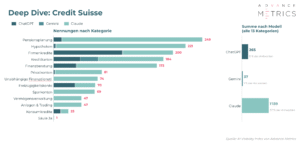
The most revealing single finding of the entire study concerns a bank that no longer exists. UBS took over Credit Suisse in June 2023, Credit Suisse AG was legally merged into UBS AG in May 2024, and in March 2026 UBS completed the migration of all former Credit Suisse clients onto its own infrastructure. Even so, Credit Suisse appears 1,441 times in the top-5 answers during the measurement period, in all 13 categories, most often in pension planning (249 mentions), mortgages (221) and business loans (200). Across all categories, that puts it in 9th place, ahead of Lombard Odier (1,409), Neon (1,311), Vontobel (1,166) and Yuh (1,108).
One model in particular clings to the old bank: 1,139 of the 1,441 mentions (79%) come from Claude, which names Credit Suisse in 37% of all its answers. ChatGPT accounts for 265 mentions (9% of its answers) and Gemini for 37 (1%).
For banks in transition, this is more than a curiosity. A bank that changes its name, merges with another institution or retires a brand doesn’t automatically lose its old visibility in the models. One plausible explanation is that, in the training data, an old name has been documented far more densely over the years than the news of its disappearance.
How Do AI Models Work?
The patterns we observed are best explained by how the models themselves work. AI models learn from publicly available text: bank websites, media coverage, comparison sites, forums, trade publications. An institution that has been present there for years also appears more often in the generated answers, simply because it showed up more often and more consistently in the training material. Credit Suisse is the clearest example.
With banks, another mechanism shows up particularly clearly. When a provider circulates under several names at once, for example as a bank, as an abbreviation, as a product brand and in different national languages, its visibility in the models’ training data is spread across several seemingly separate entries. The models themselves don’t reliably recognise these variants as the same institution. For our analysis, we were able to trace 668 such variants back to roughly 270 actual providers. Saxo Bank had the most name variants (14), followed by UBS (12, including several “UBS Key4” variants), Pictet, Finpension and Cornèr Bank (10 each) and ZKB (9, ranging from “ZKB” to “Zurich Cantonal Bank”). For Julius Bär, around 15% of mentions in the raw data use the English spelling “Julius Baer”. An AI model answering in real time doesn’t do this kind of consolidation. It falls back on the form of the name that appeared most often in its training data, and that can vary from one query to the next.
On top of that, product brands build up visibility of their own. Zak is named more often (787 mentions) than Bank Cler (765), which operates it, and Yuh, the joint offering from PostFinance and Swissquote, gets 1,108 mentions. For the bank behind a brand, this means that the brand’s visibility is not automatically its own.
The three models also don’t always draw the same conclusions from the same digital footprint. Interactive Brokers, for example, shows a clear difference in the Investing & Trading category: Claude names the broker 173 times, Gemini 111 times and ChatGPT only 3 times. Migros Bank, too, is named more than twice as often by ChatGPT (1,874 mentions) as by Gemini (784) or Claude (793). Who is “objectively the most visible” therefore depends heavily on which model you ask.
Worth knowing: the results are a snapshot of the survey period. Generative models are updated continuously, and their recommendations can change along with them. The study covers only the Swiss market and German-language queries.
How Banks and Financial Service Providers Can Increase Their AI Visibility
Without a look behind the scenes of a specific website, we can’t give serious, provider-specific recommendations. What we can share are the general principles that, in our experience, influence the AI visibility of a bank or financial service provider.
Best Practices for AI Visibility
- Use one consistent name, and actively manage name changes. As our data cleaning shows, a provider that uses its full name, abbreviation, product brands and translations inconsistently can artificially split its own visibility across several “identities”. And as the Credit Suisse example shows, an old name can still dominate in AI models.
- Make content findable for AI models. Can the models find all of your pages in the first place? Or are terms and conditions, fee tables and interest rates hidden behind JavaScript, inside calculators or in PDF documents, and therefore invisible?
- Structure content for AI models. Generative models process content in individual sections (“chunks”). Each section, on fees, interest rates or eligibility requirements, say, should make sense on its own, not only in the context of the whole page.
- Give products their own visibility. Anyone who wants to lead in a particular product should give it standalone content, not just a subpage of the general bank site. The specialists in our data who overtake the big universal banks in their category suggest this can pay off.
- Be consistent and findable across platforms. A single website is no longer enough. AI models draw their recommendations from a broader ecosystem of sources and channels, from comparison sites and media to forums.
Recommended Next Steps
- AI Visibility Audit: A stocktake of which product categories a provider already shows up in across the relevant AI models, and where it doesn’t.
- Technical GEO Check: A technical review of whether structural barriers are stopping AI models from finding and classifying an institution at all.
- Name Consistency Check: A targeted review of how many different name forms, including product brands, abbreviations and former company names, a provider circulates under in the models’ training data.
- A holistic, cross-platform content strategy that looks beyond your own website.
Conclusion
The AI Visibility Index 2026 shows that in banking, too, AI visibility can already be measured and is anything but stable across models, but with a twist compared with earlier editions of this study series. Instead of a single dominant name, the picture is split in two: five big banks are present in every category, yet in six of the 13 categories a different provider leads, among them specialists such as Neon, VIAC, Finpension and Swissquote.
At the same time, AI visibility doesn’t automatically follow market reality. A bank that no longer exists as an independent institution is still being named, and anyone looking for independent advice ends up, in the answers, mostly with banks.
One hurdle that has gone largely unnoticed so far is not a lack of quality or reputation but something more mundane: inconsistent or outdated naming that unintentionally splits an institution’s visibility in the models’ training data.
For all banks and financial service providers, the same applies: those who understand today how AI models talk about their institution, and how consistently they do it, will be better prepared for a future in which these models help shape a growing share of banking choices.
Methodology: How We Measured the AI Visibility of Banks and Financial Service Providers
For each of the 13 categories studied, we developed five questions that capture typical customer concerns, from account fees to pension planning. Two examples: “Which Swiss bank offers a private account with the lowest or no account maintenance fees?” (Private accounts) & “Which providers deliver the best return on invested capital in Pillar 3a?” (Private pension savings (Pillar 3a)). The following AI models were used for the study: ChatGPT (GPT-5.4), Claude (Claude Sonnet 4.6) and Gemini (Gemini 2.5 Flash). The survey ran over 47 measurement days between 18 August and 18 October 2026; days with incomplete data were left out. With 65 questions and three models, this adds up to more than 9,000 individual top-5 answers and more than 45,000 individual mentions, which make up the frequency figures in this article.
For the analysis, name variants of the same provider were merged and each provider was counted at most once per answer. Product brands such as Zak, Frankly or Yuh are listed separately from the banks they belong to, and Credit Suisse separately from UBS, in each case as the models name them. Foreign providers that serve customers in Switzerland, such as Interactive Brokers or Revolut, were included in the count. Generic terms such as “cantonal bank”, as well as 364 mentions of provider names that we could not verify in public sources (mostly from Claude, in the Pillar 3a and vested benefits account categories), were left out of the count. Traditional banks are defined as large banks, cantonal banks, retail and regional banks (such as Raiffeisen, PostFinance or Migros Bank) and private banks; neobanks, online brokers and other digital providers are treated separately. Providers were assigned to these types manually.