Advance Metrics’ AI Visibility Index reveals who shows up in the answers of the major AI models, who doesn’t, and why that’s becoming a competitive question for every brand.
More and more people no longer turn to a search engine like google with their insurance questions. They ask ChatGPT, Gemini, or Claude directly, about the best value for money, the right coverage for their situation, the smoothest claims process, and let the AI guide them the whole way. What they usually get back is an answer naming three to five specific providers. What they don’t get is any explanation of why those particular providers were named, and not others.
That’s exactly what we set out to investigate at Advance Metrics, systematically, over five weeks. The AI Visibility Index 2026 is the first edition of this ongoing study.
These results are a five-week snapshot. Generative models are updated continuously, and their recommendations can shift along with them. The study also covers only the Swiss market and German-language queries; results for other languages or markets could look different.
The AI Visibility Index for Insurance
- AXA dominates. Across all four categories we studied (car, home contents & liability, mobile phone, and legal protection as AXA-ARAG), AXA is the most-mentioned brand.
- Five names, nearly all the visibility. Outside of health insurance, AXA, Zurich, Allianz, Mobiliar, and Helvetia together account for almost the entire visible market.
- The three models often disagree. In health insurance, for instance, Gemini names Sanitas as its top pick 51 times, while ChatGPT does so only 30 times, less than 60 percent as often.
- A single provider can skew an entire category. For legal protection questions, Claude almost always recommends the TCS first, a pattern neither of the other two models shows. More on this below.
- Visibility follows a brand’s digital footprint, not necessarily its quality. Companies with a long-standing online presence get mentioned more often by the models, regardless of whether their offering is actually the best one.
Why AI Visibility Matters Now
User search behavior is changing. Where people once ran a Google search and clicked through three or four comparison sites, many now ask a single question to an AI assistant and simply take the answer at face value. That shifts one of the central rules of marketing from the last twenty years. Until now, the goal was to rank as high as possible on Google. Going forward, it matters just as much whether a brand gets found, and actively recommended, by the AI models themselves.
This shift has a name: Generative Engine Optimization, or GEO. And it starts with a simple question that’s gone largely unanswered so far: who do the models already recommend today, and who do they leave out?
Methodology: How We Measured AI Visibility for Insurance Providers
We didn’t want to look at isolated examples. We wanted a pattern solid enough to draw conclusions from. So we built a standardized, repeatable data collection process.
5 Questions
For each of the four insurance categories, we developed five questions that reflect real consumer concerns, from general value-for-money questions to very specific situations. Two examples (translated from the original German):
- “I have a 5-year-old car. Which insurance covers me best?” (Car insurance)
- “Which legal protection insurance actually helps when things get serious?” (Legal protection insurance)
3 AI-Models
| Model | Version | Access | Webserach | Session |
| ChatGPT | GPT-5.4 | API | disabled | new per query |
| Gemini | Gemini 2.5 Flash | API | disabled | new per query |
| Claude | Claude Sonnet 4.6 | API | disabled | new per query |
All queries ran through each provider’s API, not through the consumer chat interfaces. Web search and browsing were switched off for all three models, so every answer came purely from what the models learned during training, not from a live lookup. Each query was sent as a brand-new API call with no chat history, so that no earlier answer could influence a later one.
Timeframe and Cadence
Data collection ran from April 7 to May 11, 2026, across eleven measurement points: daily during the first week (April 7 to 13), then weekly after that (April 20, April 27, May 4, May 11). That cadence was deliberate: dense at the start to catch any short-term fluctuations, then spread out to check whether the patterns held over several weeks.
For every query, we recorded the first five providers named in the response. With 25 questions (including health insurance, see the appendix note), three models, and eleven measurement points, that adds up to more than 800 individual top-5 answers, which is what the frequency figures in this piece are built from. The data collection itself ran through an in-house automation built on the open-source platform n8n, which worked through the questions in a structured sequence and wrote every answer straight into our database.
Data Cleaning
The raw data contained a handful of spelling variants, such as CONCORDIA in all caps instead of Concordia, or an occasional typo like Protektra instead of Protekta. We merged those for the analysis. We made one deliberate exception to that rule; more on that in the next section.
Results: A Small Circle of Big Names Dominates
Across all four categories, the picture is remarkably consistent. AXA is the most-mentioned brand in every single one: 163 mentions in car insurance, 162 in home contents & liability, 165 in mobile phone insurance, and 132 in legal protection under the AXA-ARAG brand. Together with Zurich, Allianz, Mobiliar, and Helvetia, these five providers capture almost all of the visibility. Smaller providers like Smile or Baloise don’t reach even half the market leaders’ mention count, even in their strongest categories.
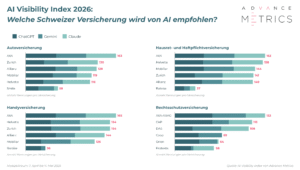
Legal protection insurance is the one category that looks different. AXA-ARAG still leads with 132 mentions, but CAP, DAS, Coop, Orion, and Protekta follow at a comparatively close distance. That suggests no single AI favorite has emerged in this category the way it has in the other three.
A small side note here: CAP actually acquired the smaller provider DAS back in 2018, yet in the AI answers, both brands still show up as independent competitors. None of the three models appears to know about, or account for, that corporate relationship.
Deep Dive: The Curious Case of TCS
The single most striking finding in the entire study centers on one brand: the TCS (Touring Club Schweiz, Switzerland’s national touring club).
For legal protection insurance, Claude puts the TCS in the number one spot for all five questions, on all eleven measurement days, without a single exception. That’s 55 out of 55 possible first-place mentions. ChatGPT and Gemini, meanwhile, don’t mention the TCS in this category even once.
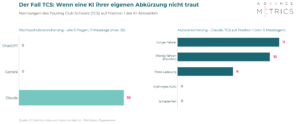
In car insurance, the pattern is more selective. Claude doesn’t place the TCS everywhere. It targets specific questions instead: for “good for young drivers,” the TCS takes the top spot in 11 out of 11 answers; for “worth it if I drive rarely,” it’s 10 out of 11. For the other three car insurance questions (general value for money, a 5-year-old car, and filing a claim), the TCS barely appears, if at all.
That’s not a coincidence. In the real world, the TCS actually builds much of its positioning around membership models aimed at exactly these groups: new drivers and occasional drivers. Claude appears to have picked up on that real-world positioning from its training data, and applies it with real precision.
Even more striking: in ten separate answers, Claude lists “TCS” in first place and then lists “Touring Club Schweiz” again further down the same top-5 list, as if they were two different companies. In those instances, the model fails to recognize its own abbreviation as the same entity as the spelled-out name.
How Do AI Models Actually Work?
The dominance of the big names is best explained by how the models themselves work, not by actual product quality. AI models learn from publicly available text: websites, comparison articles, press releases, forum posts. Brands that have maintained a presence there for years, through campaigns, editorial coverage, and comparison-site listings, also show up more often in the generated answers, simply because they appeared more often in the training material.
AI visibility, in other words, primarily tracks a brand’s digital footprint, not its quality directly. That’s also why the established names (AXA, Zurich, Allianz, Mobiliar, Helvetia) lead across every category: they simply have the largest, longest-established public presence.
Despite sharing this same underlying mechanism, the three models draw different conclusions from the same digital footprint. A glance at the totals alone would hide that.
Gemini has the longest tail. In mobile phone insurance, Gemini names five niche providers that never appear even once with ChatGPT or Claude: Digitec Galaxus Versicherung, Wefox, Simpego, simple-inSure, and Protect Your Bubble, each with exactly one mention across the entire study period. Gemini “knows about” more fringe providers, in other words, but only recommends them very sporadically.
Claude, by contrast, concentrates much more heavily on a small handful of big names, with one striking exception that gets its own section further up.
The models don’t just disagree on niche providers, though. Sometimes they disagree on the market leaders themselves. In health insurance, for example, Gemini puts Sanitas clearly in first place with 51 mentions. ChatGPT gives Sanitas only 30, less than 60 percent of Gemini’s count, leaving it stuck in the middle of the pack. Which provider counts as “objectively most visible” here depends heavily on which model you happen to ask.
How Companies Can Improve Their AI Visibility
A quick note of honesty here: without looking behind the scenes of a specific website, we can’t offer serious, company-specific recommendations. What we can share are the general principles that demonstrably shape a brand’s AI visibility.
Best Practices for AI Visibility
- Make content discoverable for AI models. Can the models actually find every page? Or is relevant content hidden behind JavaScript, invisible to them?
- Structure content for AI models. Generative models process content in individual chunks. Each chunk should make sense on its own, not only in the context of the full page.
- Cover topics holistically. To be visible for a subject, you need to address the related subtopics too, not just have one main page about it.
- Stay consistent and discoverable across platforms. A single website is no longer enough. AI models draw their recommendations from a much broader ecosystem of sources and channels.
Recommended Next Steps
- AI Visibility Audit: a stock-take of which topics and subtopics a company is already visible for with the relevant AI models, and where it isn’t.
- GEO Tech Check: a technical review of whether structural barriers are stopping AI models from finding and correctly categorizing a company in the first place.
- Qualitative analysis of site structure, content, and user experience, to prepare content that works better for AI models (and, at the same time, for Google and for actual people).
- A holistic, cross-platform content strategy that thinks beyond the company’s own website.
Conclusion
The AI Visibility Index 2026 shows that AI visibility is already unevenly distributed, measurable, and anything but stable across different models. Anyone counting on good products to simply speak for themselves is overlooking something important: an AI’s answer is, first and foremost, a question of digital presence, not product quality. For smaller brands, that adds a new, largely invisible barrier to entry. For every brand, it means a new discipline is just starting to take shape, and whoever starts understanding it early gains a head start that the next edition of this Index will be there to measure.