
The demand for content is increasing massively. At the same time, marketing teams have limited resources. GenAI is being used everywhere, but the results are disappointing. The text output is inconsistent, AI-generated texts lack relevance, and a real integration into existing content creation processes rarely exists.
AI can write texts in seconds today. So why do we still need hours per content piece? Because the typical workflow currently looks like this:
1, Write an LLM prompt
2. Review the output
3. Correct and format the text
4. Copy the text into the respective system
Each of these steps costs time and, on top of that, often produces ‘AI Content Slop’. AI Slop describes low-quality or overly generic texts created with the help of artificial intelligence. They are frequently characterized by repetitive structures, hollow phrases, buzzwords without substance, summarizing text patterns with standard phrases such as ‘Furthermore’, and excessive use of em dashes.
High-quality AI content looks different. It has structural variations in paragraph and sentence lengths, is creative and technically specific, uses activating forms of writing, and has a clear, goal-oriented tone with a distinct point of view
Automation Framework in 3 Steps
To achieve this, we at Advance Metrics have developed an Automation Framework based on three steps. Our goal was to create a scalable production system, including integrated quality control, for high-quality content.
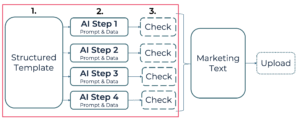
| Step 1: Structured Template | We need a structured template with all the building blocks and chapters of the desired marketing text. |
| Step 2: Deploying AI in a Multi-Step Flow | Instead of ‘Master Prompt Engineering’, the task is broken down into many simple individual steps, and a sufficient amount of input information is provided to make it as easy as possible for the AI models. |
| Step 3: Strict Control for Quality Assurance | Every AI output or every AI step requires a review within the automation to ensure that the requirements for the respective content have been met. |
Whether for ad copy, organic posts, blog articles, or website content, our framework can be applied to various types of marketing texts.
Step 1: Creating a Structured Template for Scalable Marketing Texts
Before AI writes even a single sentence, a well-thought-out template is required. This template is the starting point of every automation and defines exactly what the finished marketing text should look like. This template is not only the blueprint for AI-generated content, but also serves as a requirements catalog for quality control, making it an important pillar in quality assurance.
An AI- and UX-optimized template follows a clear hierarchy. Using a blog article as an example, this means: At the top sits an executive summary that captures the entire article in a nutshell. Below that follow the subsections or chapters, for example Topic 1, Topic 2, Topic 3, or Service 1, Service 2, Service 3. Each of these subsections in turn contains clearly defined content: use cases, benefits, examples, or other relevant elements.
The key to this is structuring the subsections in such a way that they can later be dynamically generated by AI. The same applies to the content per subsection. And the summaries are incorporated in such a way that they can be automatically generated based on the other content, not the other way around.
In practice, this means: The template is created manually and is optimized both for AI processing and for user experience (UX). In the automation tool, this template then becomes the starting point of the entire workflow.
Step 2: Deploying AI in a Multi-Step Flow
In the following step, we break down the text creation into many small individual steps. And this is arguably the biggest difference from the previous use of GenAI automation. Instead of a single ‘master prompt’ that instructs the LLM to do everything at once, we divide the tasks into individual steps and provide each step with a sufficient amount of input information. This makes it as easy as possible for the AI models to generate the desired content.
The rule is simple: one topic equals one AI step. Each content point gets its own AI call whether it’s creating the subsections, generating individual content such as use cases, benefits, or examples, or writing the summary.
What does each individual AI step need as input? Two things: a prompt and data. The prompt is not just about the task itself, but also about the context. This includes information about the company, products and services, target audience, objectives and keywords, CI/CD, tonality, and communication style. In addition, there are existing texts. These can come from the website, ads, or other sources and serve as a reference for style and content.
On the output side, we define the text type (SEO texts, ad copy, newsletter texts, product texts, social posts) and the text requirements in terms of format, length, and structure.
A clear advantage of the multi-step approach: different AI models can be tested for the respective content creation. Not every model is equally well-suited for every task. Some excel at creative writing, others at structured summaries. By breaking the process down into individual steps, the optimal model can be chosen for each step.
In our Automation Framework, this is what it looks like in practice: the structured template feeds multiple parallel AI steps, each receiving their own prompt and their own data. The outputs then come together to form the final marketing text.
Step 3: Strict Control at Every Step
Quality is not created through hope, but through systematic control. That is why in our framework, every single AI output is reviewed before it is processed further. This review can take place in two different ways: Either each AI output is checked for the basics using code. This means: Is the format correct? Is the length right? Are the required structures present? AI tools can help create this validation code.
Depending on the content, the AI output can also be reviewed using a tool. Here, the focus is on whether the inputs have been taken into account as desired: Was the tonality maintained? Is the technical content accurate? Were the keywords integrated? It is also worth testing different AI tools for this evaluation.
This strict control ensures that every single building block of the final text meets the defined requirements. Only when an output passes the respective check is it incorporated into the overall text.
Conclusion
Since the generated content is already in the correct format thanks to the created template, it can be uploaded directly to the desired platform. Content pieces can be deployed fully automatically via API, without manual copying and formatting, whether it’s a CMS, newsletter tool, or social media channel.
The entire process – from the template through multi-step AI generation with quality control to the upload – thus runs in a single automation workflow. What previously took hours per content piece becomes a reproducible, scalable system that consistently produces high-quality marketing texts. This is how a scalable production system, including integrated quality control, for high-quality content can be created.
Despite the simplified explanation of our automation approach presented here, the complexity involved in building such an automation should not be underestimated. The planning, development, and maintenance of such automations, require specialists who are proficient in both the automation tools and the AI models. Without this know-how, the framework remains a theoretical concept.
Additionally, it is important to understand that automations are naturally only suitable for text types and tasks that are truly repetitive and scalable: product descriptions for a large catalog, ad copy in various variants, recurring newsletter formats, or standardized social media posts. Anyone who wants to design every blog post individually and creatively, following different formats each time, will not get very far with an automation that follows a standardized template.
The strength of the Automation Framework therefore lies not in replacing creativity, but in elevating recurring content production to a new level of quality and efficiency.