
Advance Metrics’ AI Visibility Index shows who appears in the answers of the major AI models, who doesn’t, and why this is becoming a visibility question for every higher education institution.
More and more high school graduates, parents and career changers no longer start their search for a degree program with a search engine or a university ranking. They put their questions straight to ChatGPT, Gemini or Claude. Which university gives you the biggest boost when you start your career? Where do students get the best support? Which university of applied sciences leads in a particular subject? For questions like these, AI models now give a short answer with three to five specific names, and many users take that recommendation as the final word.
This ranking of institutions is exactly what we at Advance Metrics set out to examine systematically. The AI Visibility Index 2026 is our study series on the AI visibility of Swiss organizations. This edition focuses on universities, universities of applied sciences and other types of higher education institutions.
AI Visibility in Choosing Where to Study
We looked at 25 categories: five types of institution (university, federal institute of technology (ETH/EPFL), university of applied sciences, university of teacher education, and distance/online university) and twenty fields of study: Business & Management, Law, Social & Political Sciences, International Relations, Communication & Media, Computer Science & Data Science, Engineering & Technology, Natural Sciences, Architecture & Civil Engineering, Environment & Sustainability, Medicine & Health Sciences, Pharmacy, Psychology, Veterinary Medicine, Art & Design, Music & Theater, Education & Educational Sciences, Humanities, Sport & Sport Science, and Hotel & Tourism Management.
- No clear winner: The University of Zurich leads in 7 of the 25 categories and ETH Zurich in 4. The other 14 categories are spread across ten further institutions.
- Specialists beat the big names: The University of St. Gallen leads in Business & Management, EHL Hospitality Business School in Hotel & Tourism Management, and the Zurich University of the Arts (ZHdK) in both Art & Design and Music & Theater.
- ETH Zurich and EPFL are almost level: In most technical and scientific categories, only a handful of mentions separate them. In Natural Sciences, it’s exactly 718 to 718.
- Too many names hold visibility back: The raw data contained more than 1,000 different spellings for roughly 120 institutions, in German, French, Italian and English, with abbreviations and name variants on top.
Results: Which Institution Dominates Which Field?
Across the 25 categories, a clear split by field emerges, rather than one single dominant name.
We measure visibility in mentions: the number of times an institution appeared in an AI model’s answers (see the methodology at the end for details). Looking at the five institution types, the University of Zurich leads the university category with 644 mentions, narrowly ahead of ETH Zurich (631) and EPFL (570). Among the institutes of technology themselves, ETH Zurich is barely ahead of EPFL, with 725 mentions to 717. The race among universities of applied sciences is just as tight: Bern University of Applied Sciences (BFH, 598) and the University of Applied Sciences and Arts Northwestern Switzerland (FHNW, 594) lead ahead of ZHAW (562). Among universities of teacher education, PH Zurich (659) is just ahead of PH Bern (647). Among distance universities, UniDistance Suisse is clearly in front with 840 mentions, ahead of the Swiss Distance University of Applied Sciences (FFHS, 426) and Kalaidos University of Applied Sciences (422).
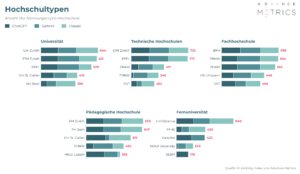
These results are a snapshot of the survey period. Generative models are updated all the time, and their recommendations can change with them. The study covers the Swiss market only, and only German-language queries.
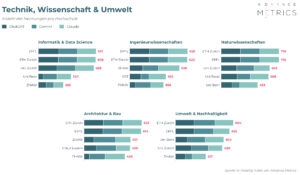
In the technical and scientific fields, ETH Zurich and EPFL dominate almost across the board, taking turns at the top. EPFL leads in Computer Science & Data Science (613 to 608) and in Engineering & Technology (626 to 623). ETH Zurich is ahead in Architecture & Civil Engineering (622 to 614) and in Environment & Sustainability (604 to 565). In Natural Sciences, it’s an exact tie at 718 to 718.
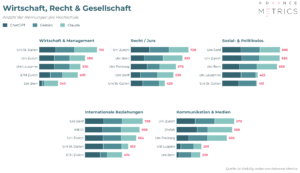
In Business & Management, the University of St. Gallen leads clearly, with 741 mentions to the University of Zurich’s 589. The University of Zurich is ahead in Law (728) and in Communication & Media (579). The University of Geneva leads in International Relations (738) and, by the narrowest of margins, in Social & Political Sciences (686 to the University of Zurich’s 682). In International Relations it is joined near the top by the specialized Graduate Institute in Geneva (698), a strong duo for the city.
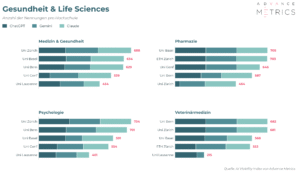
In the medicine-related fields, the lead changes hands. The University of Zurich leads in Medicine & Health Sciences (688) and in Psychology (734). The University of Basel leads in Pharmacy (705, a hair ahead of ETH Zurich at 703). The University of Bern leads in Veterinary Medicine (682, just ahead of the University of Zurich at 681, which is hardly surprising given that the two universities share the Vetsuisse Faculty).
In Art & Design (704) and in Music & Theater (682), the Zurich University of the Arts leads, ahead of ECAL in Lausanne and the Bern University of the Arts respectively. In Education & Educational Sciences (553) and in Humanities (647), the University of Zurich is in front. In Hotel & Tourism Management, EHL Hospitality Business School dominates clearly, with 720 mentions, almost twice as many as the runner-up, the Swiss Hotel Management School (385).
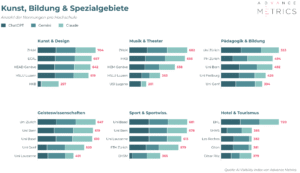
This split by field makes sense, with one important caveat. Comprehensive universities like Zurich, Bern or Basel are a plausible answer in practically every field, whereas specialized institutions such as ETH Zurich, EPFL or EHL can only compete in their own areas. Any institution that has credibly specialized in a field will be recognized by AI for exactly that field, regardless of its overall size or the breadth of its programs.
Deep Dive: ETH Zurich vs. EPFL
The most revealing single finding of the whole study is a remarkable consistency. In all seven categories where both institutions are a plausible answer, ETH Zurich and EPFL are almost always separated by a margin of between a single-digit and a low double-digit percentage.
Added up across these seven categories, ETH Zurich has 4,531 mentions to EPFL’s 4,423, a lead of just 108 mentions, or 1.2% of the combined total. And that lead is far from uniform: in Computer Science & Data Science and in Engineering & Technology, it is actually EPFL that comes out ahead, even though ETH Zurich is often seen internationally as the better-known brand.
The parity is clearest in Natural Sciences. Both institutions have exactly 718 mentions, and even broken down by model, the numbers are identical (ChatGPT 238:238, Gemini 240:240, Claude 240:240). In other words, the models don’t treat the two federal institutes of technology as rivals. They almost always retrieve them as a pair.
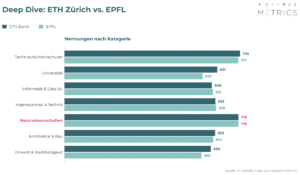
All three models narrowly favor ETH Zurich overall (ChatGPT 1,492 to 1,484, Gemini 1,557 to 1,536, Claude 1,482 to 1,403), but the gaps are small enough that a single further survey round could already flip the picture.
How Do AI Models Work?
The patterns we observed are best explained by how the models themselves work. AI models learn from publicly available text: university websites, media coverage, rankings, academic publications, alumni networks. An institution that has had a strong presence there for years also shows up more often in the models’ answers, simply because it appeared in the training material more often and more consistently.
In higher education, one mechanism shows up particularly clearly. When an institution circulates under several names at once, say a German name, a French name and an abbreviation, its visibility in the models’ training data is spread across several entries that look like separate institutions. The models don’t reliably recognize these variants as the same institution. In our analysis, we were able to trace more than 1,000 such variants back to roughly 120 actual institutions. But an AI model answering in real time doesn’t perform that consolidation. It falls back on whichever form of the name appeared most often in its training data, and that can vary from query to query.
The three models also don’t always draw the same conclusions from the same digital footprint. The University of Basel, for example, shows a stark difference in the university category: ChatGPT mentions it 168 times, Claude 170 times, and Gemini only 15 times. Who is “objectively the most visible” therefore depends heavily on which model you ask.
How Higher Education Institutions Can Increase Their AI Visibility
Without a look behind the scenes of a specific website, we can’t give sound, institution-specific recommendations. What we can share are the general principles that demonstrably influence an institution’s AI visibility.
Best Practices for AI Visibility
- Use one consistent name. As our data cleaning shows, an institution that uses its full name, its abbreviation and its translations into other national languages inconsistently can artificially split its own visibility across several “identities.”
- Make content discoverable for AI models. Can the models find all of your pages in the first place? Or is relevant content hidden behind JavaScript, making it invisible to them?
- Structure content for AI models. Generative models process content in individual sections (“chunks”). Each section should make sense on its own, not just in the context of the whole page.
- Give each field of study its own visibility. An institution that wants to lead in a particular field should present that field as standalone content, not just as a subpage of the general institution site.
- Be consistent and findable across platforms. A single website is no longer enough. AI models draw their recommendations from a broader ecosystem of sources and channels.
Recommended Next Steps
- AI Visibility Audit: an assessment of the fields in which an institution is already visible in the relevant AI models, and where it isn’t.
- GEO Tech Check (GEO stands for generative engine optimization): a technical review of whether structural barriers prevent AI models from finding and correctly placing an institution in the first place.
- Name Consistency Check: a targeted review of how many different name variants an institution circulates under in the models’ training data.
- A holistic, cross-platform content strategy that looks beyond your own website.
Conclusion
The AI Visibility Index 2026 shows that even in higher education, AI visibility is already measurable, and anything but stable across different models. This edition also has a distinctive feature compared with earlier ones in our study series. Instead of a single dominant name, we see a nuanced and largely plausible picture, in which specialized institutions regularly overtake the big names in their own fields. The biggest hurdle, and until now a barely visible one, isn’t a lack of quality or reputation. It’s something more mundane: inconsistent naming that unintentionally splits an institution’s visibility in the models’ training data. For every institution, the takeaway is the same. Those who understand today how AI models talk about them, and how consistently they do it, will be better prepared for a future in which these models help shape a growing share of study choices.