Advance Metrics’ AI Visibility Index shows who appears in the answers of the major AI models, who doesn’t, and why this is turning into a visibility question for every organisation.
In digital fundraising, AI systems are becoming a factor that can no longer be ignored. More and more people put their questions about charities straight to ChatGPT, Gemini or Claude: Which organisation is most effective in disaster relief? Which aid agency works for refugees? Which one stands up most credibly for animal welfare? Today, the models answer questions like these with a short reply and three to five specific recommendations, and many users take that advice at face value.
That is exactly what we set out to examine systematically at Advance Metrics. The AI Visibility Index 2026 is our study series on the AI visibility of Swiss organisations. This edition focuses on non-profits.
AI Visibility in Digital Fundraising
We examined 14 topic areas: human rights; women’s rights and gender equality; environment and climate protection; animal welfare; peace and conflict prevention; humanitarian aid; disaster and emergency relief; development aid and poverty reduction; child welfare; education; health and medicine; anti-corruption; refugee and migration support; and democracy promotion and press freedom.
- No single favourite: No organisation dominates across all topic areas. Instead, leadership shifts from one topic to the next, with a specialised organisation out in front in each.
- Caritas is strong across topics: It performs particularly well in four of the 14 areas. It leads in disaster & emergency relief and in refugee & migration support, and it comes in a close second in humanitarian aid and in development aid & poverty reduction.
- Results differ between AI models: Take the Swiss Red Cross in disaster & emergency relief: ChatGPT mentions it 126 times and Gemini 106 times, but Claude only 22 times.
- Language diversity skews visibility: Depending on the model, Médecins Sans Frontières is named in three different ways: in French, in German, and by its abbreviation. Only when these are added together does the organisation’s true leading position show. More on this below.
- Visibility follows the digital footprint, not necessarily impact: Organisations that have had a strong media and editorial presence for years get named more often by the models, regardless of how effective their work actually is.
Results: Which Non-Profit Dominates Which Topic?
Across the 14 topic areas, the picture is one of a clear split by field of expertise rather than a single dominant name.
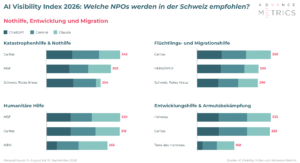
In relief, development and migration, Caritas is the most consistent performer. It leads in disaster & emergency relief (345 mentions) and in refugee & migration support (359). In humanitarian aid, however, Médecins Sans Frontières edges ahead (320 versus 318 for Caritas), and in development aid & poverty reduction Helvetas leads (333 versus 329 for Caritas).
These results are a snapshot of the survey period. Generative models are updated continually, and their recommendations can change along with them. The study covers only the Swiss market and German-language queries.
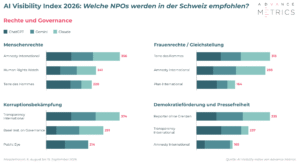
In rights and governance, Amnesty International leads on human rights (356), Terre des Femmes on women’s rights & gender equality (313), Transparency International on anti-corruption (374), and Reporters Without Borders on democracy promotion & press freedom (335).
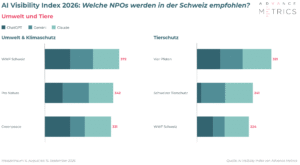
In environment and animals, WWF Switzerland leads on environment & climate protection (372, just ahead of Pro Natura with 342 and Greenpeace with 331), and Vier Pfoten (Four Paws) leads on animal welfare (321).
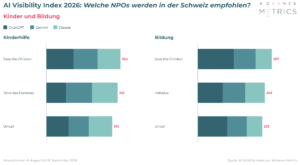
In children and education, Save the Children leads in both child welfare (354, ahead of Terre des Hommes with 341 and Unicef with 315) and education (267, ahead of Helvetas with 242 and Unicef with 233).
In health and peace, Médecins Sans Frontières leads by a wide margin on health & medicine (383), while Swisspeace leads on peace & conflict prevention (317).
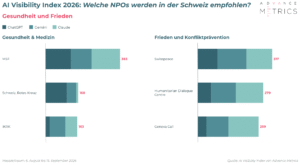
This split by field of expertise makes sense. It mirrors how the public perceives these organisations, a perception built up over years through media coverage, specialist articles and fundraising appeals. An organisation that has credibly specialised in one topic is recognised by AI for exactly that topic, regardless of its overall size.
Deep Dive: Multilingualism Is a Problem for AI Models
The most revealing finding of the entire study concerns how AI models handle multilingual organisation names, an issue of particular relevance in Switzerland with its four national languages.
The models do not name Médecins Sans Frontières consistently. Sometimes the French name appears, sometimes the German translation Ärzte ohne Grenzen, sometimes the abbreviation MSF, and sometimes a mix of these within a single answer. In the raw counts, this spreads the organisation’s mentions across several seemingly separate entries.
Only when these variants are added together does its real visibility emerge. In health & medicine, the organisation becomes the clear front-runner (383 mentions), a top position that would stay hidden if the language variants were counted separately.
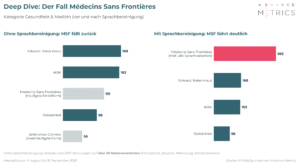
This points to a limitation of AI models: they don’t always recognise reliably that names in different languages refer to the same organisation, and so they artificially fragment its visibility. For organisations that communicate in several languages, this is a real risk of being systematically underestimated in AI answers. It isn’t that they are less visible, but that their visibility is divided among several names.
How Do AI Models Work?
The patterns we observed are best explained by how the models themselves work, not by how effective an organisation’s work actually is. AI models learn from publicly available text: websites, media coverage, fundraising campaigns and specialist publications. An organisation that has been present there for years also shows up more often in the answers the models generate, simply because it appeared more often in the training material.
AI visibility therefore follows an organisation’s digital footprint first and foremost, not its impact. That also explains why the split by field of expertise is so clear: organisations that have credibly specialised in a topic have, over the years, shaped how the public sees that topic.
The three models don’t always draw the same conclusions from the same digital footprint, though. Take the Swiss Red Cross in disaster & emergency relief: ChatGPT names it 126 times, Gemini 106 times, and Claude only 22 times. Who is “objectively the most visible” therefore depends heavily on which model you ask.
How NPOs Can Increase Their AI Visibility in Digital Fundraising
Without a look behind the scenes of a specific website, it isn’t possible to give sound, organisation-specific recommendations. What we can share are the general principles that demonstrably influence an organisation’s AI visibility.
Best Practices for AI Visibility
- Make your content discoverable for AI models. Can the models find all of your pages at all? Or is relevant content hidden behind JavaScript and therefore invisible to them?
- Structure your content for AI models. Generative models process content in individual sections (“chunks”). Each section should make sense on its own, not just in the context of the full page.
- Cover topics holistically. To be visible on a topic, you also need to cover the closely related subtopics, not just a single main page.
- Stay consistent in multilingual communication. As the Médecins Sans Frontières case shows, an inconsistently used name can artificially reduce your own visibility.
- Be consistent and findable across platforms. A single website is no longer enough. AI models draw their recommendations from a broader ecosystem of sources and channels.
Recommended Next Steps
- AI Visibility Audit: a stocktake of which topics and subtopics an organisation is already visible for in the relevant AI models, and where it isn’t.
- GEO Tech Check: a technical review of whether structural barriers prevent AI models from finding and classifying an organisation in the first place.
- Qualitative analysis of site structure, content and user experience, to prepare content more effectively for AI models (and, at the same time, for Google and for people).
- A holistic, cross-platform content strategy that looks beyond your own website.
Conclusion
The AI Visibility Index 2026 shows that even in the non-profit sector, AI visibility is already unevenly distributed, measurable, and anything but stable across models. Anyone who assumes that effective work will speak for itself is overlooking that an AI’s answer is first and foremost a question of digital presence, not of actual impact. For smaller organisations that are just as relevant in their fields, this is an additional hurdle that has so far gone largely unnoticed. For all organisations, the same holds: those who understand today how AI models talk about their work will be better prepared for a future in which these models help shape a growing share of public perception.