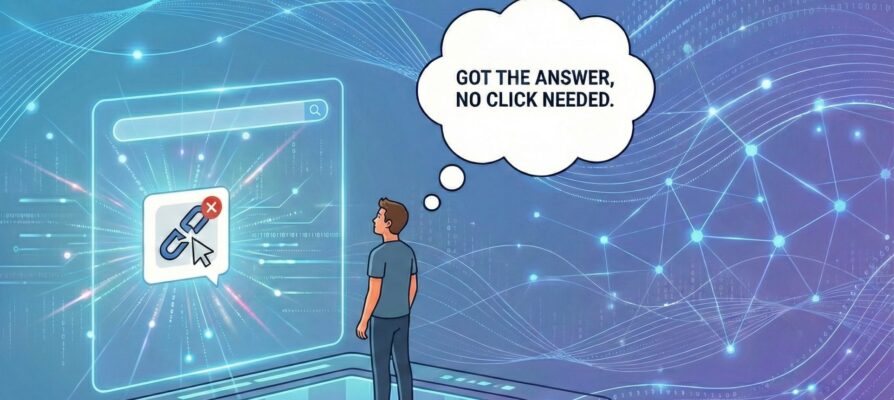
Did you know that over 70% of Google searches result in no external click? Zero-click searches have increased over time as a result of additional (AI) features added to the traditional search results page. This does not mean that traditional SEO is ineffective; it means instead, that we need to measure SEO differently by moving beyond clicks as the primary success metric.
Modern SEO success is no longer measured by clicks or traffic. As AI-driven, zero-click search experiences reshape how users discover and evaluate brands, metrics such as search impressions, SERP feature ownership, Share of Model, branded search demand, direct traffic, and assisted conversions have become the clearest indicators of the real visibility, influence, and impact of SEO.
Let us have a look at each of these key metrics, why they matter for your business, and how you could implement them today.
The 6 Key Metrics to Measure SEO Success in a Zero-Click Reality
As the search engine results page (SERP) transforms into a destination rather than a gateway, your measurement strategy must follow suit. The metrics that define success are the ones that prove whether your brand is present, cited, and remembered at the exact moment users form opinions to make purchase decisions, often without ever clicking through to your website.
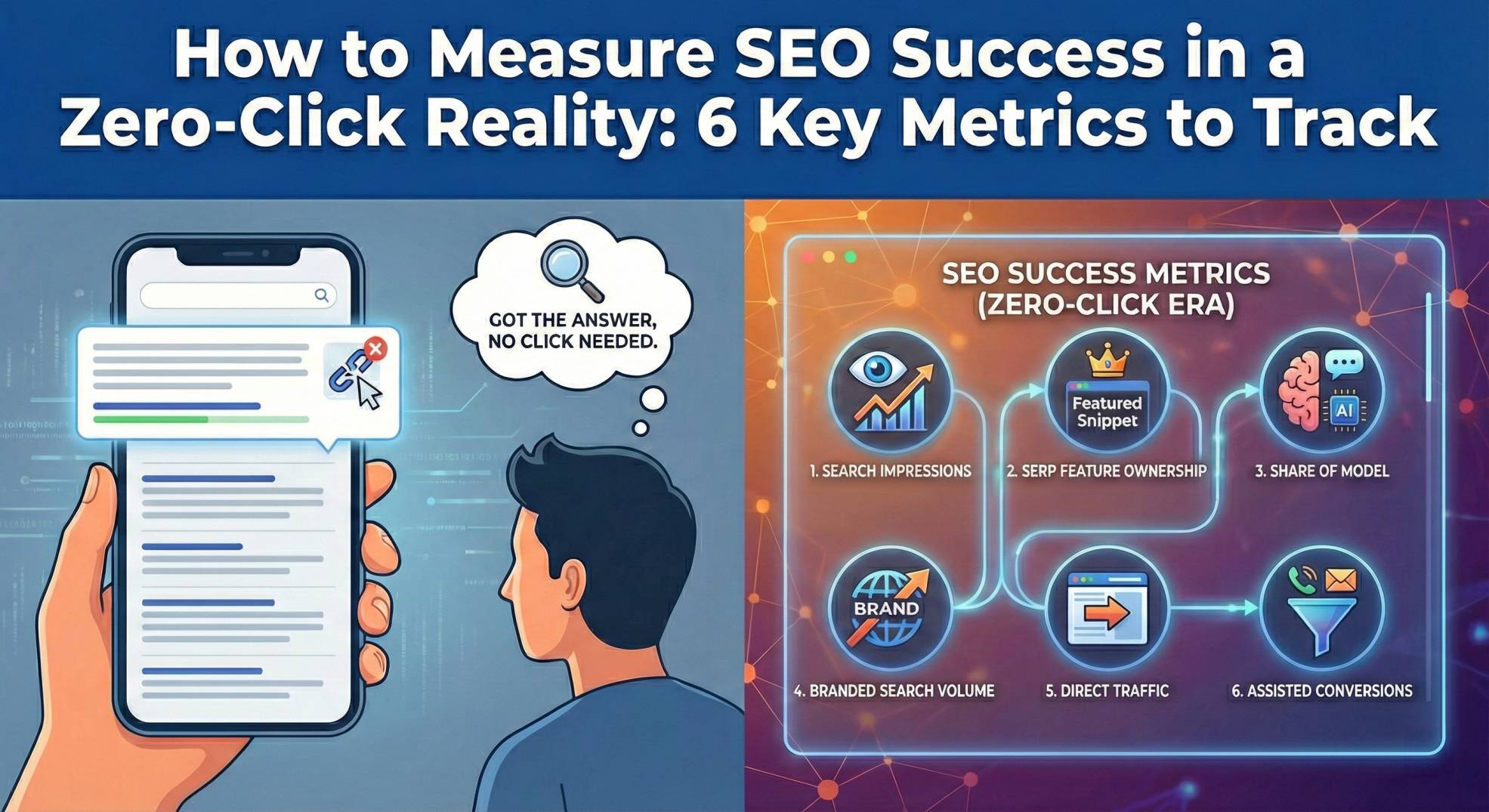
| Search impressions | Search impressions are now the primary SEO success metric, where AI-driven answers on the search page drive user interaction to zero-click experiences and visibility becomes the most effective measure of a strong SEO strategy. |
| SERP feature ownership | SERP feature ownership is now a core SEO success criterion because in a zero‑click world, most of the information transfer happens from these features, not on your website. |
| Share of Model | Share of Model (how often an LLM mentions or recommends your brand) is now a core GEO (Generative Engine Optimization) success metric as AI answers are becoming the new “results page” where many users make decisions without ever seeing a traditional SERP. |
| Branded search volume | Branded search volume is a key SEO success criterion because it is the clearest signal that your zero-click visibility is driving people to seek your brand by name. |
| Direct traffic | Direct traffic is a clear indicator of brand recall, proving that your zero-click visibility has established your brand as a destination that users visit without needing a search engine intermediary. |
| Assisted conversions | Assisted conversions are essential for measuring SEO success as they capture the value of SERP impressions and features that do not drive immediate clicks but influence conversions later. |
SEO has shifted from “capturing traffic” to “owning the answer.” By optimizing for these new indicators, you are ensuring your brand remains the primary authority in an increasingly automated world.
Search Impressions Are Now Your Most Important SEO Metric
Search impressions are now the primary SEO success metric, where AI-driven answers on the search page drive user interaction to zero-click experiences and visibility becomes the most effective measure of a strong SEO strategy.
SEO success used to be simple: rank high, get clicks. That playbook is broken. The majority of searches now end without a click.
We have moved far beyond the era of ten blue links, where the first organic position commanded a nearly 30% click-through rate. AI has fundamentally changed search. Today, AI Overviews and rich SERP features dominate the results page, pushing that first organic result down to just a 5-7% CTR (when there is an AI Overview present).
The Search results page has changed from being a gateway to bring potential customers to your website to becoming a primary brand interface where users gain valuable information without entering your site. Consequently, we need to shift our focus away from clicks toward impressions as the new key metric.
The proof is in your own data. Open your analytics dashboard and you will likely see the trend: growing impressions and shrinking clicks.
Why it matters: An impression is counted each time your content is shown in the search results page, regardless of if it is a link, a feature snippet or in an AI overview, and proves your content is being used by the search engine to inform users. Impressions are an indicator that your content is being selected, surfaced, and used by the underlying AI-driven retrieval systems.
SERP Feature Ownership Is Your New Competitive Advantage
SERP feature ownership is now a core SEO success criterion because in a zero‑click world, most of the information transfer happens from these features, not on your website.
The zero-click reality is powered by SERP features. Today’s search results are dominated by AI Overviews, Featured Snippets, Knowledge Panels, People Also Ask boxes, Local Packs, and also sponsored results, which all are sitting above or between traditional organic listings.
These features do not just complement organic results; they intercept them. They capture attention and answer queries before users ever scroll to “position one,” making feature presence a more reliable indicator of search influence than position rankings.
Users now treat SERP features as the default answer. The brand cited in a Featured Snippet or Knowledge Panel is perceived as the authoritative source, whether or not anyone clicks through.
Earning SERP features has become a success metric, overtaking traditional rank positions and clicks, especially for informational queries. To measure SEO success, you need to take into account your feature-level share of voice: your percentage of featured snippets, people-also-ask boxes, and local packs (the information pulled in from Google Maps) compared to competitors, not just your average position.
Why it matters: In a world where most searches never produce a click, the brands that win are those that dominate SERP features. If your brand consistently appears in these elements, you capture more attention, shape the narrative before anyone scrolls, and become the de‑facto expert, even when the click never happens.
Share of Model Is the New Share of Voice in the Age of GEO
Share of Model (how often an LLM mentions or recommends your brand) is now a core GEO (Generative Engine Optimization) success metric as AI answers are becoming the new “results page” where many users make decisions without ever seeing a traditional SERP.
AI is now a primary discovery channel. Large language models (LLMs) like ChatGPT, Perplexity, Gemini, or Claude synthesize the web and filter it down to a short list of summarized recommendations for users.
Unlike traditional search engines, LLMs present only a handful of curated brands or sources. The “winners” are the few the model chooses to name or cite; and if your are not in that list, you are practically invisible.
Share of Model measures how often your brand is recommended when users ask LLMs categorical questions like “What is the best CRM for small businesses?” It is your visibility score in AI-driven search, showing whether you make the short-list when users ask for recommendations.
Every AI mention is an impression. Even without a click, being named in AI responses builds awareness and credibility. Share of Model captures this exposure in the zero-click environment, indicating how well your brand is perceived and prioritized by AI systems that increasingly influence purchase decisions.
Why it matters: If the AI models do not “know” you, you do not exist in conversational search. SEO is about optimizing for LLM retrieval as much as for ranking algorithms. If your brand is not mentioned in those short lists of AI answers, you effectively have zero visibility on one of the fastest-growing decision surfaces in digital marketing.
Branded Search Volume Reveals Success in Zero-Click Visibility
Branded search volume is a key SEO success criterion because it is the clearest signal that your zero-click visibility is driving people to seek your brand by name.
Zero‑click results mean users often get what they need directly within the SERP-features. But repeated visibility in these features builds recognition and trust over time. Users may not click today, but they remember your brand.
That recognition shows up later as branded searches or high-intent queries like pricing or comparison—searches that sit much closer to conversion.
Branded search volume is where you see the downstream impact of impressions, SERP features, and LLM mentions that do not drive an immediate click.
Think of branded search volume as a simple but powerful brand‑health metric and predictor of future market share. As organic clicks decline, branded volume is where you see the real ROI of impressions and features: it shows whether all that exposure is actually converting into people seeking out your brand specifically.
Why it matters: When zero-click searches satisfy a user’s initial curiosity, they often remember the brand and search for it directly later. Branded search volume is the zero‑click era’s trusted truth metric: it proves your impressions are converting to active brand demand, not just passive views.
Direct Traffic Validates Brand Recall and Authority
Direct traffic is a clear indicator of brand recall, proving that your zero-click visibility has established your brand as a destination that users visit without needing a search engine intermediary.
One of the most successful outcomes of a search impression is the user bypassing the search engine entirely. When a user sees your brand consistently cited in AI Overviews or Featured Snippets, your brand becomes synonymous with the solution they need.
Direct traffic captures the “Invisible Funnel” of users who encountered your brand via an LLM or a SERP feature and later typed your URL directly into their browser.
Tracking direct traffic allows you to see the transition from brand discovery to brand loyalty. It is the ultimate proof that your SEO strategy is building long-term equity rather than just chasing temporary clicks.
One caveat is that AI-driven discovery platforms do not always pass traditional referral data; as a result, a win in a conversational AI tool sometimes manifests as a “Direct” visit in your analytics.
Why it matters: Direct traffic is the purest measure of brand recall. It shows that your presence in zero-click environments was impactful enough to turn a casual searcher into a deliberate visitor. When direct traffic trends upward alongside your search visibility metrics, it indicates your zero-click presence is reinforcing brand awareness in ways that drive intentional visits.
Assisted Conversions Capture SEO’s Hidden Value in Zero-Click Search
Assisted conversions are essential for measuring SEO success as they capture the value of SERP impressions and features that do not drive immediate clicks but influence conversions later.
The path to purchase is no longer a straight line from “Search → Click → Buy.” A user might see your brand in an AI Overview on Monday (zero-click), encounter a retargeting ad on Wednesday, and finally convert via direct visit on Friday. Traditional last-click attribution would give SEO zero credit for that sale, despite initiating the entire journey.
That is why assisted conversions matter. They track touchpoints like organic search impressions that contribute to a sale but are not the final click. In the SEO context, they credit zero-click exposures, like SERP features, AI Overviews, or snippet appearances, when users later convert via branded search, direct traffic, or social media channels.
While you get fewer clicks in zero-click search, the traffic that does reach your site is more targeted and pre-qualified. These users have already seen your brand multiple times and are further along in their decision process, which is why conversion rates from AI-assisted organic traffic often outperform traditional search.
Last-click attribution fundamentally undervalues SEO in today’s landscape. Over 70% of searches now resolve on the SERP without a click, but that exposure still shapes customers decisions. Assisted conversions solve this by distributing credit across the full customer journey, capturing SEO’s role in research and awareness even when it does not generate the final click.
Why it matters: Based purely on last-click metrics, SEO might look like a “failing” channel. Assisted conversions reveal the true impact of being visible during the critical research phase, proving that your zero-click impressions are driving conversions further along the user journey.
What the New Zero-Click Reality Means for Your Business
The zero-click reality fundamentally changes how search drives business growth: it shifts SEO from a traffic acquisition channel to a brand authority and demand creation engine. For your company, this means search success now lives in visibility metrics like impressions, SERP feature ownership, Share of Model, branded search volume, direct traffic, and assisted conversions—signals that reveal whether you are dominating the decision-making moment before users become customers.
Traditional SEO reporting focused on clicks and last-click revenue often shows declining performance, while search is working hardest at the top of the funnel. Rising impressions, feature wins, and share of model correlate with conversion lifts: more branded queries (proving recall), higher assisted conversions (proving influence).
Measuring SEO success in a zero-click reality requires a measurement overhaul, away from the singular focus of clicks and toward more meaningful metrics in the new age of AI.
Advance Insights: How SEO Wins in a Zero-Click World
Understanding these new zero-click metrics is only the starting point; the real challenge lies in adapting your daily strategy to match them.
As Advance Metrics’ SEO expert, I bring over five years of experience helping brands adapt to evolving search landscapes. I often hear the same concerns about zero-click optimization and how to maintain growth even as traditional traffic metrics decline.
To bridge the gap between the data we just discussed and real-world application, I have outlined the most frequent questions I receive on making this transition successful.
Question: What is the single biggest mistake you see companies make when responding to the zero-click trend?
Answer: They panic and abandon SEO entirely, or they double down on outdated tactics. The biggest mistake is viewing zero-click as a threat rather than an evolution. Smart brands recognize that appearing in AI Overviews or featured snippets, even without clicks, builds trust and authority. When users see your brand as Google’s source of truth, you are winning even if they do not click immediately.
Question: How should B2B companies specifically approach zero-click optimization differently than B2C?
Answer: B2B buying cycles are longer and involve multiple touchpoints, which actually makes zero-click less threatening. Your prospect might see your brand answer a technical question in an AI Overview, then encounter you again in industry research, then finally convert weeks later. For B2B, focus on owning informational queries in your niche and becoming the cited expert, which builds the credibility that drives conversions later.
Question: What is your take on optimizing specifically for AI Overviews versus traditional featured snippets?
Answer: AI Overviews pull from multiple sources and synthesize information differently, so you cannot just optimize for the top position anymore. The key is comprehensive, authoritative content that answers the full user intent, including follow-up questions. Structure content with clear hierarchies, specifically for AI retrieval, and ensure your expertise signals (author bios, citations, credentials) are prominent. AI Overviews favor sources that demonstrate topical authority across multiple related queries, not just one-off answers.
Question: What tactical changes should companies implement immediately?
Answer: Audit your content for “snippet-ability:” can your answers stand alone? Restructure key pages to have concise, direct answers in the first 40-60 words, then expand with supporting details. Use proper heading hierarchy and structure answers in formats that Google and AI-models love: tables, numbered steps, and comparison frameworks. This is not about gaming the algorithm; it is about improving data retrieval and user experience, genuinely answering user questions in the most accessible way possible.
Question: Looking ahead 2-3 years, how do you see the zero-click landscape evolving?
Answer: Search will become even more conversational and contextual, with AI agents handling multi-step research on users’ behalf. Brands that own topical authority across entire subject areas will be successful. We will also see a premium on unique insights, proprietary data, and expert interviews, things AI cannot synthesize from existing content. Companies that invest in original research, expert perspectives, and genuine thought leadership will have a goldmine that pure content optimization cannot replicate.
Your Next Steps for Zero-Click SEO Success
The zero-click reality means that the value of SEO has shifted higher up the user journey. SEO is a visibility, credibility, and demand-generation engine as well as a traditional traffic channel. The search results page has changed from being a gateway to becoming a primary brand interface. Measuring success purely by clicks risks underinvesting in one of the most powerful growth levers to win mindshare across SERPs and AI-driven answers.
If you are ready to evolve your reporting beyond the click and start capturing your true influence in the AI era, we can help. Our SEO and content strategy services are built specifically for the zero-click era, helping brands like yours measure what truly matters and optimize for visibility where decisions are actually made. Let us take a look at how search is influencing your growth today and where your biggest opportunities lie.